Rain Dance Papers · Volume I · Essay 22
The Basin, the Towel, and the Pulpit
Servant Leadership, Wounded Identity, and the Quiet Revolution of Christ
There are moments in history that change the world through power.
And then there are moments that change the world through humility.
The night before His crucifixion, Jesus did neither what His disciples expected nor what any king in history would have considered appropriate.
He picked up a towel.
To modern readers, this appears to be little more than an act of kindness. To those gathered in the Upper Room, it was almost unthinkable.
The roads of Judea were dusty. Travellers wore sandals. By the time guests arrived for a meal, their feet were covered with dust and dirt. Washing a guest’s feet was the responsibility of the lowest servant in the household. It was a task so humble that even many Jewish servants were exempt from it. It belonged to those without status.
Yet on that evening, there was no servant.
There was only silence.
The silence itself tells a story.
The disciples were not discussing Scripture. They were not praying. They were arguing.
Luke tells us that “a dispute also arose among them as to which of them was considered to be greatest” (Luke 22:24).
Matthew adds another layer. The mother of James and John approached Jesus requesting that her two sons should sit at His right and left hand in His Kingdom. The remaining disciples became indignant—not because they had understood Jesus’ teaching, but because they wanted those places themselves.
Their argument was not merely about leadership.
It was about proximity.
Who would sit closest to Jesus?
Who would become His chief minister?
Who would have the greatest authority?
Who would be remembered as the first among equals?
The irony is breathtaking.
While they debated who deserved the highest seat, no one was willing to kneel at the lowest place.
The basin remained untouched.
Then Jesus stood.
Without rebuking them.
Without raising His voice.
Without delivering another sermon.
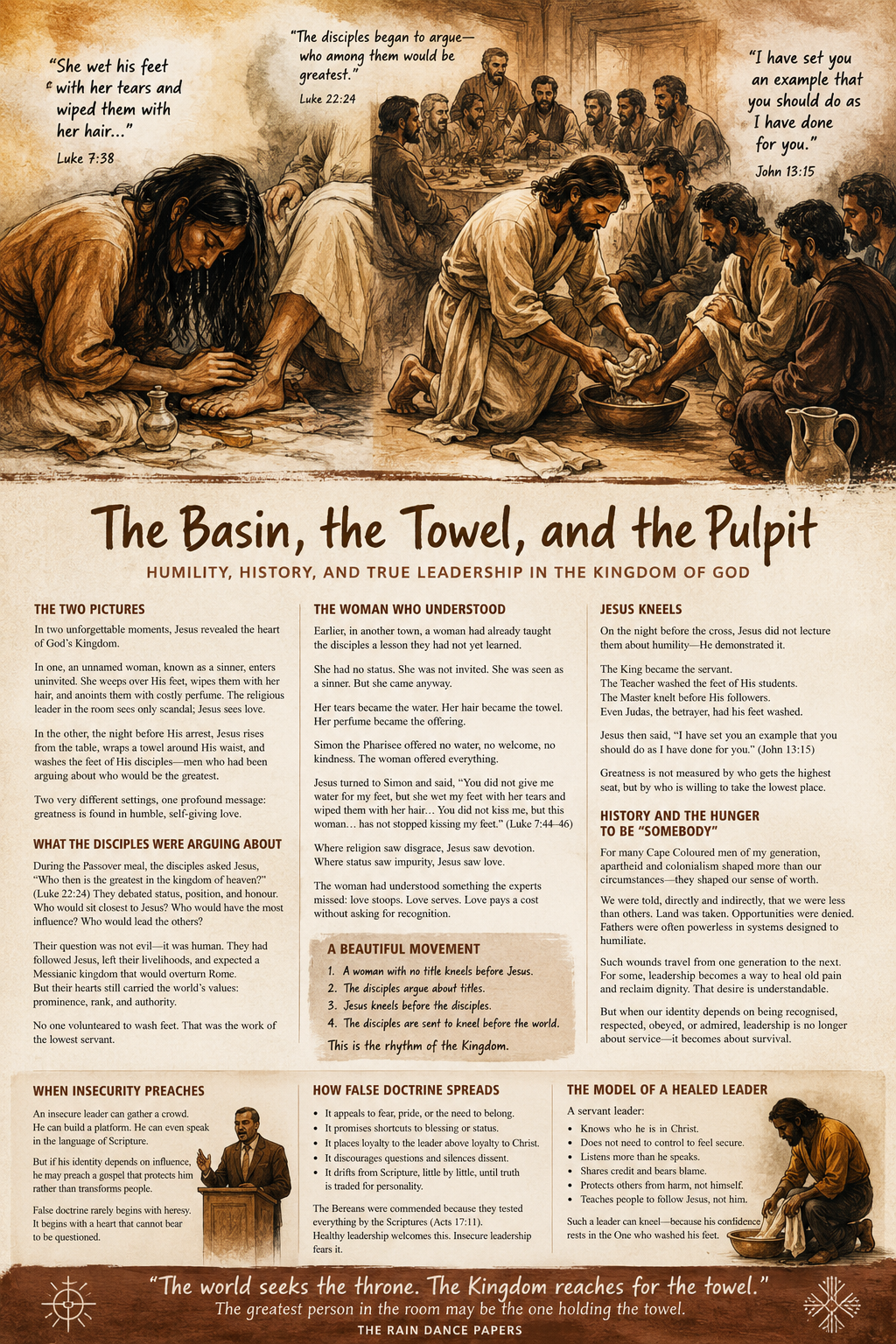
He removed His outer garment, wrapped a towel around His waist, poured water into a basin and began washing the feet of His disciples.
One by one.
Peter.
John.
Thomas.
James.
Even Judas.
Jesus already knew Judas would betray Him before sunrise.
Still He washed his feet.
That single act may be one of the greatest sermons ever preached.
The disciples wanted to be near the throne.
Jesus walked toward the towel.
He did not abolish leadership.
He redefined it forever.
“Whoever wants to become great among you must be your servant.”
The Kingdom of God had turned the world’s understanding of greatness upside down.
Yet this was not the first time Jesus’ feet had become the centre of an extraordinary lesson.
Earlier in His ministry, while dining in the home of Simon the Pharisee, an unnamed woman entered the room.
Luke simply describes her as “a sinful woman.”
She had no religious credentials.
No public reputation.
No title.
No platform.
No recognised authority.
She carried only a jar of perfume.
Standing behind Jesus, she began to weep.
Her tears fell upon His feet.
Unable to find a towel, she loosened her hair—a gesture considered deeply improper in public—and wiped His feet with it.
She kissed His feet.
She anointed them with perfume.
Simon watched with quiet contempt.
He questioned both the woman’s character and Jesus’ discernment.
Yet Jesus saw something Simon had completely missed.
Simon had offered no water.
No kiss of welcome.
No oil for His head.
The respectable religious leader had neglected the ordinary acts of hospitality.
The woman, whom society considered morally unworthy, gave everything she possessed.
Her tears became the water.
Her hair became the towel.
Her perfume became the offering.
Long before the apostles argued about greatness in the Upper Room, this unnamed woman had already understood something they had not yet learned.
Love willingly stoops.
Humility does not ask who is watching.
It asks who needs serving.
There is a beautiful progression in the Gospel narrative.
A woman with no title kneels before Jesus.
The disciples argue about titles.
Jesus kneels before the disciples.
Then He sends those same disciples into the world to become servants rather than masters.
This is the rhythm of the Kingdom.
Unfortunately, history teaches us that humanity often chooses another rhythm.
We seek platforms instead of towels.
Recognition instead of responsibility.
Titles instead of character.
Power instead of service.
South Africa knows something about the formation of identity.
Colonialism and apartheid did not merely remove land, divide families and restrict opportunity. They also reshaped how people understood themselves. Entire communities were classified, measured and valued according to systems they neither created nor controlled. Human dignity became tied to race, occupation, education and proximity to power.
Such systems leave scars that often survive long after the laws have disappeared.
Many fathers were denied opportunities.
Many sons grew up watching men struggle to exercise authority over their own lives.
Many communities learned, consciously or unconsciously, that significance had to be earned through status rather than received through dignity.
For some Cape Coloured men of my own Generation X, this historical inheritance may have contributed to a deep longing to become “somebody.” It is important to say that this is neither universal nor unique. Similar patterns can be found in many societies marked by oppression, poverty or exclusion. But history has a way of shaping expectations about what leadership should look like.
When dignity has been repeatedly denied, the desire to reclaim it is understandable.
Leadership itself is not the problem.
The problem begins when leadership becomes a substitute for identity.
An insecure man often seeks followers before he has learned to serve.
He seeks recognition before responsibility.
He seeks authority before wisdom.
He seeks influence before character.
Because his identity depends upon remaining important, disagreement feels like rebellion.
Questions become threats.
Correction becomes disrespect.
Service begins to disappear.
The towel quietly slips from his hands.
This danger is nowhere more serious than inside the Church.
Churches are meant to reflect Christ.
Instead, they sometimes reflect the surrounding culture.
Titles become badges of honour.
Platforms become symbols of importance.
The pulpit becomes a throne.
Leadership becomes measured by visibility rather than faithfulness.
In such an environment, false doctrine does not always begin with false theology.
Sometimes it begins with wounded identity.
A man whose sense of worth depends upon being seen as God’s special representative may gradually shape Scripture around himself. Certain passages become emphasised because they reinforce his authority. Others are neglected because they encourage accountability, mutual submission or servant leadership.
Slowly, Christ becomes less visible.
The leader becomes more visible.
The congregation may not even notice the shift.
False doctrine rarely arrives wearing a name tag.
It often arrives wearing confidence.
It speaks with certainty.
It discourages difficult questions.
It presents loyalty to the leader as loyalty to God.
History reminds us how dangerous this can become.
The New Testament repeatedly warns believers not to surrender their discernment.
The Bereans were praised because they examined Paul’s teaching against the Scriptures every day.
Paul himself instructed the Thessalonians to “test everything; hold fast what is good.”
John urged believers to “test the spirits.”
The apostles expected thoughtful disciples, not passive followers.
Healthy leadership therefore welcomes examination.
It does not fear it.
The remarkable truth is that Jesus, who possessed all authority in heaven and on earth, never demanded unquestioning allegiance to His own status.
Instead, He washed feet.
His authority was never insecure because His identity was never insecure.
He knew who He was.
Therefore He had nothing to prove.
Perhaps this is the deepest lesson of the basin and the towel.
The disciples reached for the highest seat because they were still searching for significance.
The unnamed woman knelt because she had discovered love.
Jesus knelt because He already knew His identity.
History still presents us with the same choice.
We can build churches around personalities or around Christ.
We can pursue influence or faithfulness.
We can seek the throne or carry the towel.
One produces followers.
The other produces servants.
One protects status.
The other transforms lives.
The Kingdom of God was never built by those who fought to sit closest to Jesus.
It was built by the One who quietly knelt before them all.
Perhaps the greatest leader in the room is still the one holding the towel.
The World Seeks the Throne. The Kingdom Reaches for the Towel.